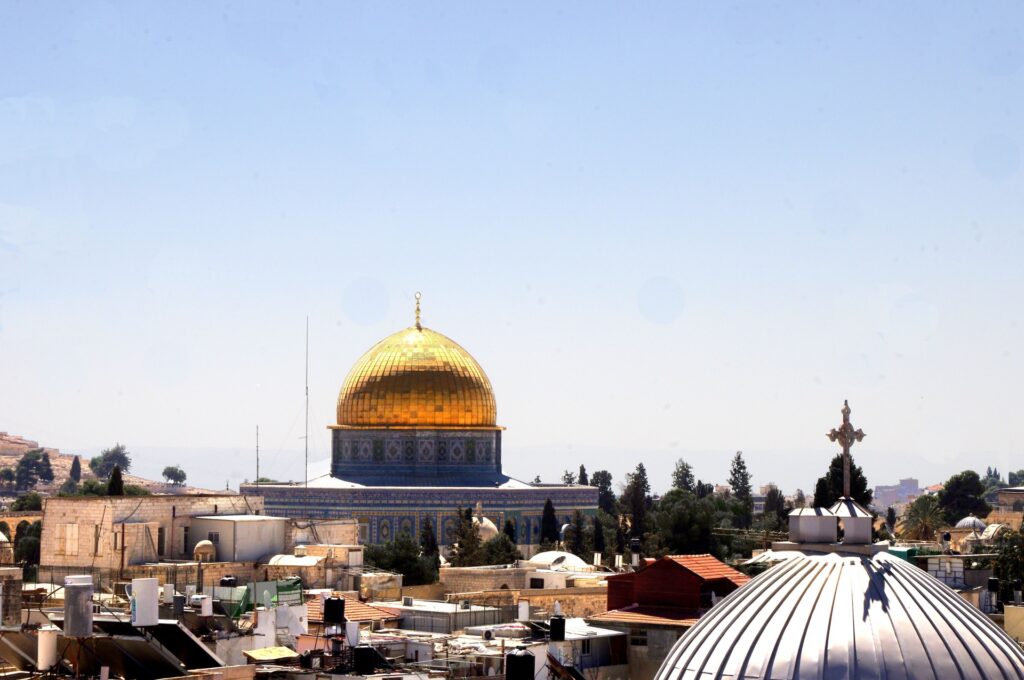
Happy Eid-al-Fitr to all those who celebrate it! This week, Nick Timothy MP wrote an article in the Telegraph, criticising Muslims who gathered in London’s Trafalgar Square to pray in public at the end of Ramadan. It made me wonder if the MP in his title stands for ‘moral panic’ rather than Member of Parliament…
Let me start by saying that freedom of religion and belief and freedom of expression are fundamentally important to me and I see these rights as vital components of the way in which liberal democratic states should be governed. I respect your right to examine the evidence (or not) and come to your own conclusions about the nature of the universe, including whether a God exists or not, etc. We might regard each other as deeply mistaken about key aspects of the world, but I expect the same respect and consideration for my beliefs and judgement as I extend to yours.
I think that’s the most disturbing thing about Nick Timothy’s position: he declines to extend this consideration to the Muslim community on the basis of the UK’s long Christian heritage in terms of “laws and norms and our institutional, intellectual and cultural inheritance”. In his view, you’re not ‘allowed’ to take views or actions in the public realm that put you at a radical distance from that Christian heritage. Clearly, that privileges existing traditions and power structures, and is just as much an expression of political power as the public prayer that Timothy criticises. (It’s interesting to note that the abridged version of his article that I saw republished in a right-wing, anti-Islam magazine called the New English Review, omitted a paragraph discussing this Christian heritage, suggesting it saw this as one of the weaker arguments in Timothy’s article.)
Timothy takes issue with the adhan, the Muslim call to prayer. It sounds alarming when he describes it as “a repudiation of other beliefs”. But that is not a distinctive property of the adhan. Any truth claim logically implies the falsity of its inverse: if the God of the Bible is true, all others must be false; if the sky is blue, it cannot also be not-blue. So this objection has no real force and should be disregarded. (Timothy cites the examples of church bells and the Nicene creed to draw a distinction between direct and indirect/personal truth claims about God. But all this does is insert a layer of abstraction between the act and the truth claim: church bells would not ring out if the parishioners did not gather to recite the Nicene creed to profess their belief in God, and so on. The political nature and consequences of belief remain active in the background.)
So, how should the public realm operate? In my view, it should ideally reflect the free marketplace of ideas set out by John Stuart Mill in his treatise On Liberty. Different religions and political traditions should compete on an equal basis for adherents, with only those restrictions required to prevent significant harm to individuals (e.g. to restrict the operation of cults and protect vulnerable people from exploitation). The playing field should not be stacked in favour of one religion or system, but should allow people to switch between them according to their own best judgement, and people should be encouraged to exercise wise judgment in these matters for the benefit of society as a whole. Public spaces then become neutral spaces, rather than spaces inherently intended to favour a specific subsection of the population, and public prayer holds no inherent threat to the enjoyment of the public space by others.
Timothy’s article goes on to criticise the UK government’s work on a definition of Islamophobia, claiming that its purpose is to “shut down debate”. But the government’s website about the new working definition takes great pains to make clear that it is a non-statutory definition for policy-making purposes, and doesn’t alter existing laws around freedom of expression, including the right to express hostility to others within the boundaries of the law. Sorry, Nick, but I need to see a lot more evidence of some vast government conspiracy to silence critics of Islam before I jump on that bandwagon.
I hesitate to accuse Timothy of racism; as a previous victim of hate crime, I’d reserve that label for the kind of in-person incidents I’ve experienced in the past and reported to police. Nor do I particularly support the kind of public in-your-face-with-my-megaphone street preaching that you sometimes see when out and about; I reported one such street preacher to British Transport Police after a particularly unpleasant encounter on the Tube, where such behaviour is against Transport for London’s bylaws, and I joined the National Secular Society after the incident to directly oppose the street preacher’s aims.
But positions like the one Nick Timothy takes, rooted in a factional, small-c conservative view of society and requiring buy-in on the basis of shared Christian heritage, really don’t help to move the debate forwards, and are themselves examples of the domination and division that Mr Timothy claims to oppose.
Further reading
- Nick Timothy, March 2026. Islamic domination of the public sphere is unacceptable. https://www.telegraph.co.uk/news/2026/03/19/islamic-domination-of-public-sphere-is-unacceptable/. Article by Nick Timothy MP, Shadow Secretary of State for Justice, in the Telegraph, criticising public prayer by Muslims in Trafalgar Square. The abridged version in the New English Review is here: https://www.newenglishreview.org/islamic-domination-of-the-public-sphere-is-unacceptable/
- Ben Quinn, March 2026. Tory peer accuses Nick Timothy of ‘instilling fear’ over Islamic prayers. https://www.theguardian.com/politics/2026/mar/21/tory-peer-tariq-ahmad-nick-timothy-muslims-islamic-public-prayers. Criticism of Nick Timothy’s position by Tariq Ahmad, a Conservative peer, and a summary of other developments since Timothy’s article was published.
- UK Ministry of Housing, Communities and Local Government, March 2026. A Definition of Anti-Muslim Hostility. https://www.gov.uk/guidance/a-definition-of-anti-muslim-hostility. As described on that page, it’s an “overview of the government’s new non-statutory definition of anti‑Muslim hostility, what it seeks to address and its intended application”.