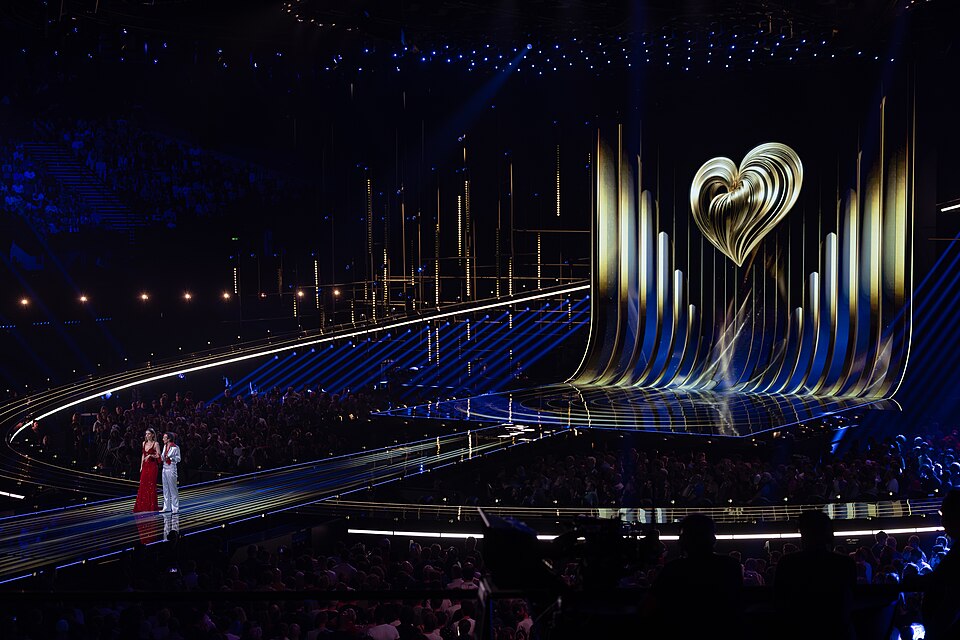
Picture a contest, widely televised and increasingly popular, in which each participating region sends a representative or two to compete in a grand tournament that has only one winner. While the audience are dazzled by the glamour and glitz of the contestants and the hosts, the contest actually serves higher political and cultural goals, specifically, maintaining unity and harmony, and dissent naturally can’t be tolerated.
Happy Hunger Games!
No, it’s not the Hunger Games I’m talking about. But in some ways, Eurovision has recently become more like the dystopian regime of Panem described in Suzanne Collins’ bestselling series.
Since 2024, the European Broadcasting Union has been under pressure to exclude Israel from participation. That would have been the right move to safeguard the contest’s future, in my opinion. As widely reported, since September 2025 the government of Israel has been accused of carrying out a genocide by international experts on a United Nations Commission of Inquiry; it cannot be business as usual for the EBU while such allegations remain credible, and we saw this year that a number of participating national broadcasters agreed, with Spain, Ireland, Iceland, Slovakia and the Netherlands eventually withdrawing from the contest. There has also been a movement among the fan community to boycott Eurovision; personally, I didn’t watch the live shows at all and many of those whom I know usually watch it haven’t either.
It must be a fragile system…
It’s also shameful that the EBU banned Russia in 2022 after Russia started a war of aggression against Ukraine, yet Martin Green, the director of Eurovision since 2024, recently described the ban as a technicality due to the Russian state broadcaster VGTRK not having sufficient independence from the Kremlin, and confirmed that Russia could theoretically return to participating – undermining the importance of shared European values in EBU decision-making.
Despite that, at a time when public service broadcasting is under attack for speaking truth to power, there is some merit in the argument that Israel’s public service broadcaster Kan has broken no rules and should be permitted to compete. However, Kan being independent from the Israeli government didn’t stop Netanyahu’s office from funding a million-dollar mass voting campaign in support of the Israeli acts in 2024 and 2025 – tactics that were, mind-bogglingly, considered not to be excessive by the EBU! A New York Times report last week found that the public vote in countries such as Spain could easily have been skewed by a few hundred highly motivated voters voting repeatedly for Israel to win. Excluding Kan would therefore have sent a strong message that the EBU will not tolerate attempts by any government to manipulate the outcome of the competition for soft power purposes – a missed opportunity that I worry will lead to problems in future.
To maintain confidence in the integrity of the results, the voting rules were changed before the 2026 contest in a frankly weird and convoluted bundled vote that avoided national broadcasters having to directly vote on Israel’s participation (which could have caused Israel’s allies, such as Germany and possibly this year’s host Austria to withdraw). In attempting to keep both supporters and critics of Israel on side, perhaps for financial reasons, it seems to me that the EBU is abandoning sensible practices and serious debate over how the principles of public service broadcasting are embodied in Eurovision, doing everyone involved a disservice.
The whole world is an arena
Some participating broadcasters have suggested that the EBU should exclude countries at war from participating to maintain the integrity of the voting, a rule that would neatly preclude Russia, Ukraine and Israel from competing without casting judgment on the morality of the wars involving those countries. But I’m concerned that this would open the contest to criticism that Eurovision hypocritically calls for peace while denying victims of state aggression a cultural platform, and that it represents an out of touch group of countries who can afford to hold a lavish cultural celebration of European unity while others suffer in the shadows – just as the wealthy elite in Panem’s Capitol remained ignorant of the misery and oppression in the Districts. Would this be better than a highly politicised contest? I’m not sure – as a review in the Guardian shows, Eurovision has always been deeply political; it’s what audiences are used to, and the results aren’t necessarily undermined by it – it’s part of the appeal for many viewers.
A little hope?
All this criticism aside, it’s only in the last five years that I’ve gotten more invested in Eurovision, and in that time I want to emphasise that it has been a whole lot of fun! I’ve sung Eurovision entries by Olly Alexander and Claude at karaoke, attended watch parties in London and Cardiff, and thoroughly enjoyed entertaining moments like this joyously exuberant sign language interpreter’s performance of Erika’s thinly-disguised paean to sex, Ich Komme. The fact that this year the spotlight is on the contest’s clumsy attempts to separate art and politics is ultimately the fault of the EBU.
With the results of the 2026 competition now in, I expect Martin Green can breathe a sigh of relief that disaster (a win by Israel) has been averted for now. But the EBU will need to do a lot more to earn back the trust of those who have decided not to watch this year. I’m just not sure the odds are in their favour.
Further reading
- United Nations Office of the High Commissioner for Human Rights, September 2025. Israel has committed genocide in the Gaza Strip, UN Commission finds. https://www.ohchr.org/en/press-releases/2025/09/israel-has-committed-genocide-gaza-strip-un-commission-finds. UN press release regarding the findings of the UN Independent International Commission of Inquiry on the Occupied Palestinian Territory.
- Dave Keating, May 2026. I’m a Eurovision superfan, but this year’s contest brings only sadness. I won’t be tuning in. https://www.theguardian.com/commentisfree/2026/may/16/im-a-eurovision-superfan-but-this-years-contest-brings-only-sadness-i-wont-be-tuning-in. Commentary on the European Broadcasting Union’s mismanagement of the dissatisfaction around Israel’s participation in Eurovision.
- Maria Hvistendahl and Alex Marshall, May 2026. How Israel Turned Eurovision’s Stage Into a Soft Power Tool. https://www.nytimes.com/2026/05/11/world/europe/eurovision-israel-gaza-netanyahu.html. New York Times exposé of the Israeli government’s efforts to promote Israel’s Eurovision acts in previous years, and the feeble responses of the contest organisers when concerns were raised.
- Volodymyr Ivanyshyn, May 2026. UK lawmakers slam Eurovision director for not ruling out Russian participation during war. https://kyivindependent.com/british-lawmakers-slam-eurovision-director-for-not-ruling-out-russian-participation-during-war/. Criticism of Martin Green’s interview claim that Russia could participate in Eurovision if its state broadcaster were independent of the Russian government, as reported in the Kyiv Independent.
- Rory Carroll, May 2026. How did Eurovision go from sequins and flares to geopolitical slugfest? https://www.theguardian.com/tv-and-radio/2026/may/16/eurovision-boycott-protest-history A look back at the political aspects of past Eurovision contests, starting with boycotts of Spain and Portugal during the period that those countries were governed by dictators.